Brick Market DACH 2026: Market Position, Product Groups and Key Players
The DACH brick market comprises four main segments in 2026: masonry bricks for load-bearing and non-load-bearing walls, clinker and facing bricks for double-leaf facades, roof tiles made from fired clay, and ceramic tiles ranging from stoneware to fine stoneware large-format. Production volumes in Germany amount to approximately 9.8 billion normal-format units (NF) of masonry bricks, 1.2 billion facing bricks and approximately 280 million m² of roof covering per year. Wienerberger, as market leader in Austria and with strong presence in Germany, leads the consolidation process, while regionally specialized manufacturers such as Hagemeister, Ströher and Petersen remain present in the clinker segment, and Braas, Erlus and Creaton in the roof tile sector.
Technical development in 2026 concentrates on three focal points: firstly, the optimization of thermal insulation bricks for monolithic construction with λ-values around 0.07 W/(m·K), secondly, the reduction of specific primary energy demand in brick production from currently 2,800–3,200 kWh/t fired brick to below 2,500 kWh/t through process heat recovery and alternative fuels, thirdly, adaptation to GEG 2024 with U-value requirements ≤ 0.24 W/(m²·K) for external walls in new construction. The bulk density of modern high-hole bricks ranges between 650 and 800 kg/m³, filled flat bricks with perlite or mineral wool filling achieve values around 700 kg/m³ while simultaneously improving thermal insulation.
Clinker bricks with bulk densities of 1,900–2,100 kg/m³ and compressive strengths above 50 N/mm² continue to dominate ventilated facing brickwork and representative facades. Roof tiles made from clay compete with concrete roof tiles, with clay tiles having a service life of 80–100 years and concrete roof tiles 50–60 years. Ceramic tiles in interior and exterior applications comply with DIN EN 14411 requirements for water absorption, bending tensile strength and abrasion resistance, with fine stoneware featuring ≤ 0.5 % water absorption as standard for external applications and heavily stressed interior areas.
Masonry Bricks 2026: Filled Flat Bricks, Thermal Insulation Bricks and High-Hole Bricks
Masonry bricks are classified according to DIN 105-100 by compressive strength classes, bulk density and hole pattern. The development of high-hole bricks with optimized web-chamber design enables λ-values between 0.07 and 0.09 W/(m·K) without additional insulation layer. Wienerberger Porotherm bricks achieve U-values around 0.21 W/(m²·K) with perlite filling in 36.5 cm wall thickness, Schlagmann Poroton bricks with mineral wool filling achieve comparable values at 42.5 cm thickness. Compressive strength classes typically range between 4 and 12 N/mm², with compressive strengths ≥ 8 N/mm² required for load-bearing external walls in multi-storey construction.
Flat bricks with tongue-and-groove system and integrated mortar pocket reduce thin-bed mortar consumption to below 1 l/m² wall area compared to 15–20 l/m² with conventional bed joint mortaring. The reduced thermal bridge formation through continuous butt joint interlocking improves the effective U-value by 5–8 % compared to conventional masonry. Brick formats are based on NF (240 × 115 × 71 mm), common flat bricks measure 365–425 mm in longitudinal direction at heights of 249 mm (large-format).
Filled bricks contain perlite (expanded volcanic rock with λ ≈ 0.045 W/(m·K)), mineral wool (λ ≈ 0.035 W/(m·K)) or EPS granulate (λ ≈ 0.032 W/(m·K)). Filling occurs after the firing process at temperatures of 950–1,050 °C to prevent material degradation. Wienerberger uses perlite filling for Porotherm T Profi with λ-values of 0.07 W/(m·K) at 36.5 cm wall thickness, while Schlagmann Poroton WDF with mineral wool achieves λ-values of 0.071 W/(m·K) at the same format. Compressive strength remains at 6–8 N/mm² compared to unfilled high-hole bricks almost constant, as the filling primarily lies in the chambers and does not infiltrate the statically effective webs.
| Brick Type | Manufacturer / Model | Format (L×B×H mm) | Bulk Density (kg/m³) | λ (W/(m·K)) | Compressive Strength (N/mm²) | U-Value at 36.5 cm (W/(m²·K)) |
|---|---|---|---|---|---|---|
| Filled Flat Brick | Wienerberger Porotherm T Profi | 365×249×249 | 680 | 0.070 | 6 | 0.21 |
| Filled Flat Brick | Schlagmann Poroton WDF | 365×248×249 | 700 | 0.071 | 8 | 0.20 |
| High-Hole Brick Unfilled | Wienerberger Porotherm S9 | 365×240×249 | 750 | 0.09 | 10 | 0.26 |
| Thermal Insulation Brick | Unipor WS10 Coriso | 365×300×249 | 650 | 0.075 | 4 | 0.23 |
| High-Strength Solid Brick | Traditionally Fired | 240×115×71 | 1,800 | 0.60 | 28 | — |
Production occurs through extrusion processes with subsequent cutting and drying at 100–120 °C over 24–48 hours. The firing process at 950–1,050 °C takes 18–30 hours in tunnel kilns with lengths of 100–140 m. Modern facilities utilize waste heat recovery for predrying and achieve specific energy consumption of 2,500–2,800 kWh/t finished product. CO₂ emission amounts to 180–220 kg CO₂/t brick, with 60–70 % from fuel (natural gas, increasingly biogas) and 30–40 % from decarbonation of lime-bearing clays (CaCO₃ → CaO + CO₂).
Clinker and Facing Bricks: Hagemeister, Ströher, Petersen and Regional Specialists
Clinker bricks are produced by firing at 1,100–1,250 °C until initial sintering, resulting in nearly pore-free ceramics with bulk densities of 1,900–2,100 kg/m³. Water absorption according to DIN 105-4 amounts to maximum 6 %, high-quality clinker achieves < 3 %. Compressive strengths exceed 50 N/mm², with hand-struck formats typically achieving 60–80 N/mm². Clinker bricks are primarily used as facing bricks in double-leaf external walls with 11.5 cm thickness, followed by an air gap or core insulation of 6–10 cm mineral wool (λ = 0.035 W/(m·K)) to the load-bearing inner leaf made of masonry, reinforced concrete or timber construction. The resulting U-value ranges from 0.18–0.22 W/(m²·K) depending on insulation thickness.
Hagemeister produces approximately 80 million NF clinker bricks annually at sites in Nottuln and Bad Essen in over 120 varieties. The product range includes hand-struck clinker with vibrant surface texture (Island BA+FU, Dublin), charcoal-fired treated varieties with reduced blue and black tones, and standardized formats for cost-sensitive projects. Ströher focuses on ceramic facade systems and clinker brick slips with thicknesses of 14–20 mm for curtain walls and ETICS cladding. Petersen Tegl from Denmark supplies hand-struck premium clinker bricks with characteristic surface structures and color gradations created through charcoal firing and wood firing.
Frost resistance is tested according to DIN 52252 through F-cycle tests: 50 freeze-thaw cycles with water storage result in < 5 % mass loss for compliant clinker. Compressive strength correlates with firing temperature and clay composition; illitic clays from northern Germany yield clinker with 55–65 N/mm² at 1,150 °C, kaolinitic clays from southern Germany only 45–55 N/mm² at the same temperature. Color variation occurs through iron oxide content (red tones at 2–6 % Fe₂O₃) and firing atmosphere (oxidizing atmosphere yields red tones, reducing atmosphere blue to black tones).
Clinker brick slips with thicknesses of 14–20 mm and weights of 30–40 kg/m² are applied via thin-bed mortar or adhesive anchors to solid walls, ETICS surfaces or ventilated substructures. Advantages lie in lower weight and subsequent installability without double-leaf wall construction. Disadvantages are limited ventilation capability and higher substrate preparation requirements. Hagemeister, Ströher and Feldhaus Clinker offer system-compliant slip solutions with coordinated mortars and joint materials.
Clay Roof Tiles and Concrete Roof Tiles: Braas, Erlus, Creaton in Comparison
Clay roof tiles and concrete roof tiles divide the 2026 market for pitched roofs with inclinations ≥ 22° (standard coverage). Clay roof tiles are produced by firing at 1,000–1,100 °C and feature bulk densities of 1,900–2,100 kg/m³, water absorption of 8–12 % and bending tensile strengths around 15 N/mm². Concrete roof tiles consist of cement, sand and water with pigmentation, have bulk densities of 2,000–2,200 kg/m³ and bending tensile strengths of 10–12 N/mm². The service life of clay roof tiles is 80–100 years, concrete roof tiles achieve 50–60 years, with surface coatings increasing weathering resistance for both materials.
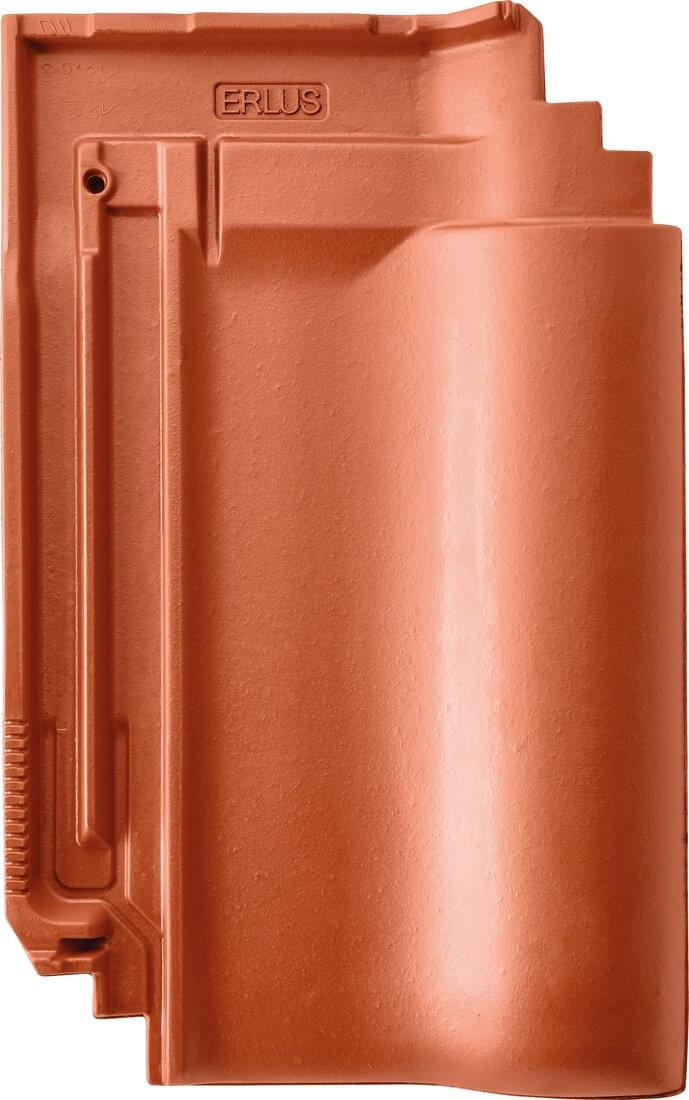
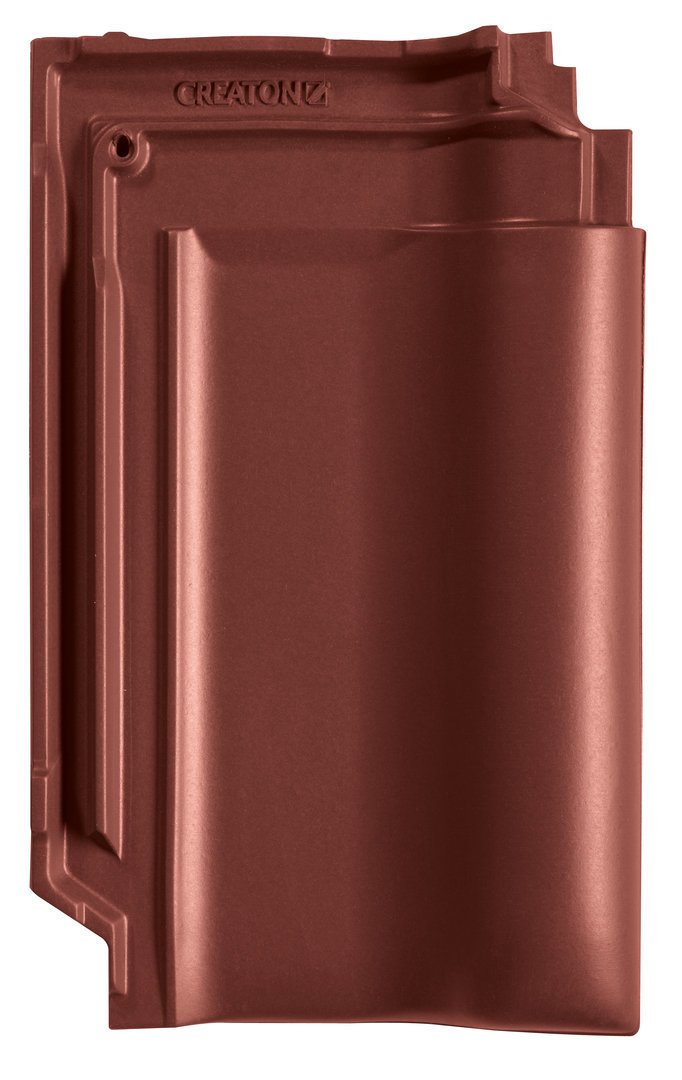
Braas (part of the BMI Group) produces concrete and clay roof tiles in Germany at multiple sites with annual capacities of over 100 million m² roof area. The product range includes flat roof tiles (Frankfurt Pan, Tegalit), double-trough ridge tiles (Rubin, Emerald) and large-formats (Topaz). Erlus focuses on clay roof tiles with 22 tile models and 31 colors, including engobed (mineral coating) and glazed (glaze application at 1,050 °C) variants. Creaton offers clay roof tiles in classic forms (shingle, Harmony) as well as the engobed large-format Terra Optima.
Coverage quantities vary between 9 pieces/m² for large-format roof tiles and 22 pieces/m² for shingle tiles. Area weight ranges from 45 to 65 kg/m² for clay tiles and 40 to 50 kg/m² for concrete roof tiles. Roof structure load capacity must be dimensioned accordingly: at 60 kg/m² coverage, 25 kg/m² battens/counter-battens and 100 kg/m² snow load, total load on rafters equals 185 kg/m². Minimum roof inclination is 22° for flat roof tiles, 30° for shingles, for large-formats sometimes only 10° with additional measures (underfelt, increased overlap).
| Product | Manufacturer | Material | Format (L×B mm) | Coverage (pcs/m²) | Weight (kg/m²) | Minimum Roof Inclination |
|---|---|---|---|---|---|---|
| Frankfurt Pan | Braas | Concrete | 330×420 | 10 | 42 | 22° |
| Rubin 11V | Braas | Clay | 330×420 | 11 | 52 | 22° |
| Ergoldsbacher E58 | Erlus | Clay | 290×470 | 9.5 | 48 | 16° (with underfelt) |
| Terra Optima | Creaton | Clay Engobed | 340×420 | 10 | 55 | 22° |
| Shingle | Wienerberger/Creaton | Clay | 165×365 | 22 | 60 | 30° |
The integration of photovoltaic modules as in-roof systems gains significance in 2026. Wienerberger, Braas and Erlus offer PV tiles and suspension systems that comply with DIN EN 1991-1-4 (wind loads) and DIN EN 1991-1-3 (snow loads). Electrical output amounts to 150–200 Wp/m² roof area, with monocrystalline cells achieving efficiencies of 20–22 %. Installation is performed by specialized roofers with electrical engineering certification.
Ceramic Tiles: Stoneware, Fine Stoneware and Large-Format Slabs According to DIN EN 14411
Ceramic tiles are classified according to DIN EN 14411 into groups: Group I (Fine stoneware with water absorption ≤ 0.5 %), Group IIa (Stoneware 3–6 %), Group IIb (Stoneware 6–10 %), Group III (Earthenware > 10 %). Fine stoneware dominates 2026 with over 70 % market share in the DACH region, as it is frost-resistant and suitable for both interior and exterior applications. Compressive strength exceeds 1,300 N, bending tensile strength ≥ 35 N/mm². Abrasion resistance according to PEI scale reaches PEI V for unglazed fine stoneware tiles (highest demand in commercial and public areas).
Large-format slabs with dimensions up to 1,600 × 3,200 mm and thicknesses of 3–12 mm are printed using digital printing processes with up to eight colors, creating realistic wood, stone and concrete looks. Manufacturing occurs through dry pressing at pressures of 400–500 bar followed by firing at 1,200–1,250 °C. The λ-value of fine stoneware amounts to 1.3 W/(m·K), bulk density 2,300–2,400 kg/m³. Installation occurs in thin-bed with flexible adhesive mortars class C2 according to DIN EN 12004, with joint widths of 3–5 mm for calibrated formats and 2 mm for rectified formats.
Ceramic tiles for exterior areas must be frost-resistant according to DIN EN 202, ensured through maximum water absorption of 0.5 % (fine stoneware). Slip resistance is classified according to DIN 51130 (R-value for barefoot areas) and DIN 51097 (A, B, C for wet rooms). Exterior coverings in public areas require R11 or higher, pool surrounds at least R13 + C. Manufacturers such as Agrob Buchtal, Deutsche Steinzeug and Villeroy & Boch offer system-compliant tiles with matching profiles, skirting boards and stair edges.
Wienerberger as Market Leader: Strategy, Production Capacities and Acquisitions 2026
Wienerberger operates in over 26 countries with more than 200 production sites and generates approximately 2.1 billion EUR revenue in the Building Solutions segment (masonry bricks, roof tiles, ceramic pipes) with EBITDA margins of 18–20 %. In Germany, Wienerberger operates twelve brick plants with annual capacity of approximately 1.8 billion NF masonry bricks and five roof tile plants with 45 million m² roof area. In Austria, market leadership amounts to over 60 % in the masonry brick segment and 40 % in roof tiles. Strategy focuses on three pillars: firstly, portfolio expansion through acquisitions (2026 acquisition of 50 % + 1 share in Italcer for 82 million EUR enterprise value to strengthen ceramic tile segment), secondly, decarbonization of production through alternative fuels (target: -30 % CO₂ by 2030 versus 2020), thirdly, digitalization of sales and logistics processes.
The Italcer acquisition provides Wienerberger access to 60 million m² annual tile production capacity in Italy, Russia and the USA, with high-end design collections and technical large-formats (up to 1,600 × 3,200 mm) complementing the product portfolio. The purchase price of 82 million EUR for the first tranche implies an EV/EBITDA multiple of approximately 8, with options on further shares until 2028 exercisable at a guaranteed minimum EV of 560 million EUR for 100 %. Integration shall proceed with minimal disruption by retaining existing management and regional brands (Italcer, Cerim, Alfalux).
In the DACH region, Wienerberger strengthens market position through the Brick Bonus 2026 in Austria, incentivizing builders with direct discounts of 500–2,000 EUR depending on project size. Product innovations focus on digital planning tools (Porotherm Online Planner with U-value calculation, material quantity determination and quotation preparation), prefabricated wall elements (pre-cut from factory and delivered pallet-wise) and integrated installation chases in flat bricks for electrical and plumbing lines. Sustainability strategy includes deployment of green hydrogen in tunnel kiln pilot projects from 2027 onwards and recycling of brick debris to brick chips for drainage and substrates.
Energy Consumption and CO₂ Balance of Brick Manufacturing 2026
Brick production requires 2,500–3,200 kWh/t finished product, of which 60–70 % accounts for the firing process. Modern tunnel kilns with 100–140 m length and firing times of 18–30 hours utilize waste heat recovery for predrying and air preheating, reducing specific energy consumption by 15–20 % versus older chamber kilns. Fuel in 2026 consists of 85–90 % natural gas with heating values of 10 kWh/m³, increasingly supplemented with biomethane (5–10 %) and wood waste (2–5 %). CO₂ emission amounts to 180–220 kg CO₂/t brick, with 120–140 kg from combustion and 60–80 kg from decarbonation of lime-bearing clays (process-related emission).
The decarbonization strategy pursues three approaches: firstly, substitution of fossil fuels with green hydrogen (pilot projects with burners for H₂/natural gas mixtures up to 30 % H₂ share), secondly, utilization of waste heat for electricity generation via ORC systems (Organic Rankine Cycle with 100–200 kW electrical output), thirdly, reduction of process-related emissions through lower-lime clay blends or CCS (Carbon Capture and Storage). Wienerberger, Schlagmann and Unipor have communicated CO₂ reduction targets of -25 to -30 % by 2030, with focus on Scope-1 emissions (direct emissions from firing process).
The primary energy index (PEI) of masonry bricks amounts to 3,500–4,200 MJ/m³ including raw material extraction and transport. For comparison: autoclaved aerated concrete achieves 2,800–3,200 MJ/m³, calcium silicate brick 1,200–1,500 MJ/m³, reinforced concrete 2,500–3,000 MJ/m³. The Global Warming Potential (GWP) of high-hole bricks amounts to 120–160 kg CO₂-eq/m³, filled flat bricks 140–180 kg CO₂-eq/m³ (including perlite/mineral wool filling). Life cycle assessment according to DIN EN 15804 shows that bricks offer advantages over the 50-year use phase through high durability and maintenance-free operation compared to lightweight construction materials with shorter maintenance cycles.
GEG 2024 and U-Value Requirements for Brick External Walls
The Building Energy Act (GEG) 2024 requires U-values ≤ 0.24 W/(m²·K) for external walls in new construction as maximum value for reference building comparison. Monolithic brick walls made from filled flat bricks achieve U-values of 0.20–0.21 W/(m²·K) at 36.5 cm wall thickness, at 42.5 cm 0.17–0.18 W/(m²·K). Double-leaf construction with 11.5 cm clinker facing brickwork