Insulation Material Market DACH 2026: Technical Performance, Regulatory Framework, and Supply Chains
The insulation material market in the DACH region faces multiple pressures in 2026: The Building Energy Act (GEG) 2024 tightens U-value requirements for new construction and renovation, the EU taxonomy demands demonstrable CO₂ reduction across the entire lifecycle, and technical building regulations define stricter fire protection classes for multi-story timber structures. In parallel, market shares are shifting: while expanded polystyrene (EPS) still accounted for approximately 38% of volume in DACH new construction in 2025, mineral and organic insulation materials are gaining market share — not only for ecological but also for building physics reasons.
This article analyzes the five dominant insulation material classes according to technical parameters, regulatory requirements, and economic viability. The basis is DIN EN 13162–13171, the building regulatory approvals of the DIBt as well as market data from Ceresana and FMI for 2026. The evaluation is based on measurable parameters: thermal conductivity λ (W/mK), bulk density ρ (kg/m³), fire behavior according to DIN EN 13501-1, diffusion resistance μ, specific heat capacity c (J/kgK), and Global Warming Potential GWP (kg CO₂-eq/m³) according to DIN EN 15804.
The decisive factors for material selection in 2026 are no longer U-values alone, but the combination of fire protection, summer heat protection (phase shift), moisture variability, and deconstruction capability. The standard revision DIN 4108-4:2024 also introduces more differentiated sd-value classes for diffusion-open constructions, which particularly favors wood fiber insulation materials.
Insulation Material Classes Overview: Synthetic, Mineral, Organic — Parameters and Applications
Insulation materials can be divided into three main groups based on raw material base, which have different building physics profiles. The classification according to DIN EN 13162–13171 defines product-specific test procedures and declaration requirements for each.
| Insulation Material | λ (W/mK) | ρ (kg/m³) | Fire Class | μ-Value | c (J/kgK) | GWP (kg CO₂-eq/m³, A1–A3) |
|---|---|---|---|---|---|---|
| EPS (White-Gray) | 0.030–0.038 | 15–30 | B1/E | 20–50 | 1450 | 3.8–5.2 |
| XPS | 0.032–0.036 | 28–45 | B1/E | 80–200 | 1450 | 4.1–6.0 |
| PUR/PIR | 0.023–0.028 | 30–60 | B2–B1/E-D | 30–100 | 1400 | 5.5–8.9 |
| Glass Wool (WLG 032) | 0.032–0.040 | 12–100 | A1–A2 | 1–2 | 1030 | 1.2–2.8 |
| Stone Wool (WLG 035) | 0.035–0.045 | 30–200 | A1 | 1–2 | 1030 | 1.5–3.1 |
| Wood Fiber (Flexible) | 0.038–0.050 | 40–70 | E/B2 | 3–5 | 2100 | -18 to -8 (CO₂-negative) |
| Wood Fiber (Rigid) | 0.040–0.055 | 110–270 | E/B2 | 3–5 | 2100 | -25 to -12 |
| Cellulose (Blown-in) | 0.038–0.045 | 30–80 | B2/E | 1–2 | 2000 | -5 to +2 |
Synthetic insulation materials (EPS, XPS, PUR, PIR) are characterized by low λ-values and low bulk density, but possess high μ-values (diffusion-inhibiting) and moderate heat storage capacity. Mineral insulation materials (glass wool, stone wool) are non-combustible (A1/A2), diffusion-open (μ=1–2), and dominate in fire protection. Organic insulation materials (wood fiber, cellulose, hemp) offer high heat storage capacity c, which enables phase shifts of 10–14 hours — essential for summer heat protection according to DIN 4108-2.
The choice of insulation material depends primarily on the application area: EPS and XPS for perimeter insulation (XPS: EN 12228, pressure-resistant up to 700 kPa), mineral wool for pitched roofs and fire walls, wood fiber for diffusion-open timber construction and internal insulation, PUR/PIR when space is limited (e.g., flat roof renovation).
EPS and XPS: Application Areas, Fire Protection Issues, and Recycling Capability 2026
Expanded polystyrene (EPS) remains the most widely used insulation material by volume in the DACH region in 2026, particularly for thermal insulation composite systems (TICS) and basement exterior walls. The distinction between white EPS (λ=0.035–0.038 W/mK) and graphite-containing gray EPS (λ=0.030–0.032 W/mK) is no longer regulatory relevant — what matters is the declared thermal conductivity level according to DIN EN 13163. Manufacturers such as Knauf Therm (Knauf XTherm for WLG 031), BASF Neopor, and Sto predominantly offer graphite-enhanced variants in 2026, as these allow 15–20% thinner layers for the same insulation performance.
Extruded polystyrene (XPS) achieves higher compressive strength (200–700 kPa according to DIN EN 12088) through closed-cell structure and is primarily used for perimeter insulation, trafficable terraces, and inverted roofs. The μ-value of 80–200 makes XPS almost vapor-tight — problematic for timber construction, optimal for earth-contact components. Typical products: Knauf Therm Perimeter Plate, Austrotherm XPS TOP, Bachl XPS.
Fire Protection: EPS and XPS are classified as B1 (hard-to-ignite) according to DIN 4102, but classified as Class E (normal fire behavior) according to DIN EN 13501-1. This discrepancy leads to stricter requirements in 2026: The Model Administrative Regulation for Technical Building Code (MVV TB 2023/03) requires for buildings of building class 4 and 5 with TICS using combustible insulation materials additional fire barriers made of mineral wool (minimum 200 mm height) on each floor. For hybrid timber structures from 7 m height, non-combustible insulation materials (A1/A2) are required.
Recycling and Circular Economy: The RL 01/2021 (Recycling Guideline) of the DIBt classifies HBCD-free EPS as recyclable. Systems such as PolyStyreneLoop (BASF, Knauf) and Creasolv (Bewi) enable material recycling to rEPS with up to 35% recycled content. Heidelberg Materials and Holcim integrate crushed EPS demolition waste as lightweight aggregate in lightweight concrete in 2026 (bulk density reduced to 1,200–1,400 kg/m³), which reduces landfilling. However, the recycling rate remains at approximately 25–30%, as many TICS demolition waste is contaminated by plaster adhesion and bonding.
The GWP balance for EPS is 3.8–5.2 kg CO₂-eq/m³ (cradle-to-gate, DIN EN 15804), for XPS is 4.1–6.0 kg CO₂-eq/m³. Compared to mineral wool (1.2–3.1 kg CO₂-eq/m³), this is approximately twice as high, but still significantly below PUR/PIR systems.
Mineral Wool: Glass Wool vs. Stone Wool — Technical Differences and Manufacturer Specifics
Mineral wool comprises two product groups: glass wool (DIN EN 13162) made from waste glass, sand, and binder, and stone wool (DIN EN 13162) made from basalt, diabase, or dolomite. Both are non-combustible (Class A1 according to DIN EN 13501-1, melting point >1,000 °C) and diffusion-open (μ=1–2), but differ in bulk density, compressive strength, and application area.
Glass Wool achieves thermal conductivity of 0.032–0.040 W/mK at bulk densities of 12–100 kg/m³ and is primarily used for pitched roofs (between-rafter insulation), timber frame construction, and partition walls. The low bulk density enables large insulation thicknesses with low self-weight. Typical products in 2026: Knauf Insulation Unifit TI 135 U (WLG 035, λD=0.035 W/mK), Isover Integra ZKF-1 (WLG 032), Ursa Pureone (formaldehyde-free binder). The dynamic stiffness s' is 5–15 MN/m³ — sufficient for impact sound insulation under floating screeds according to DIN 4109-32.
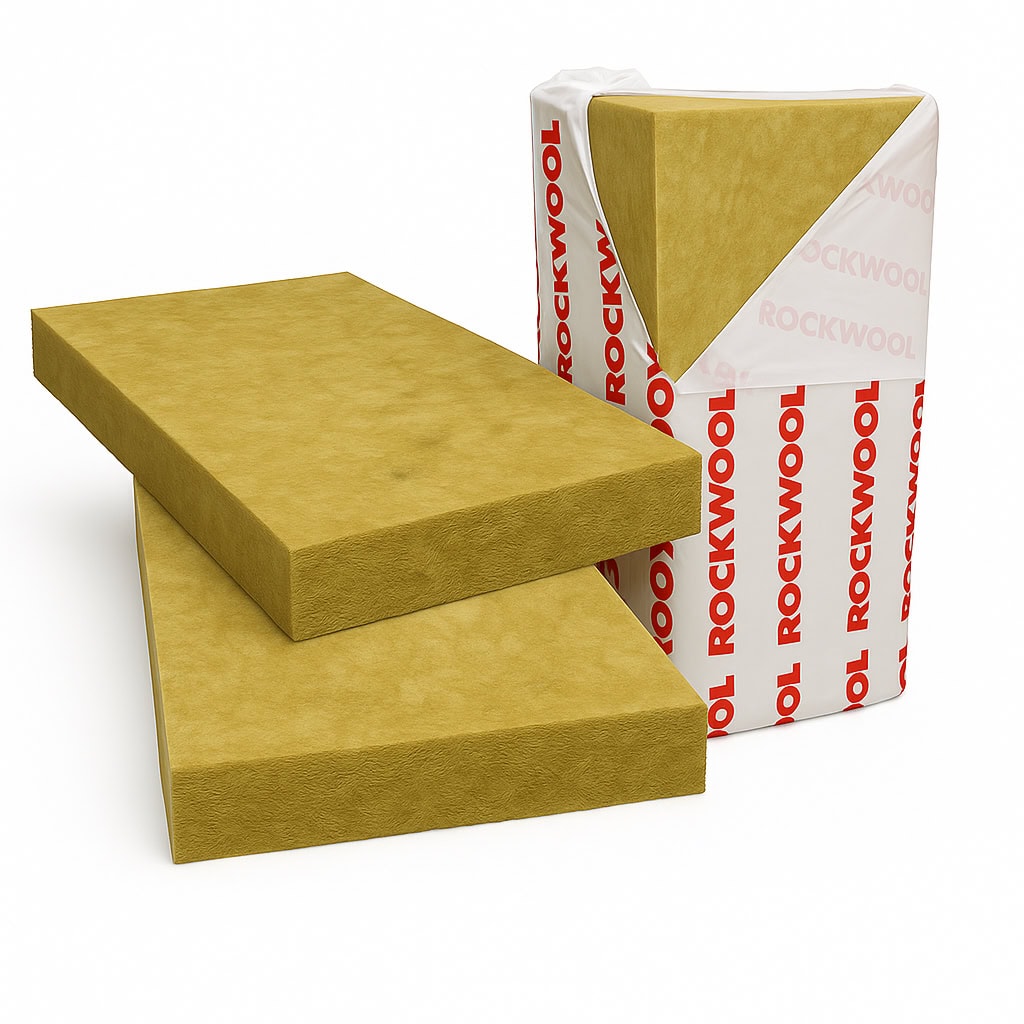
Stone Wool possesses better compressive strength (10–70 kPa according to DIN EN 826) through higher bulk densities (30–200 kg/m³) and is the standard material for flat roofs, floor slabs, and fire protection applications. Rockwool Hardrock (170 kg/m³, compression-resistant up to 60 kPa) is used for trafficked flat roofs, Rockwool Sonorock for acoustic suspended ceilings (rated sound reduction index Rw up to 62 dB according to DIN EN 10140). Knauf Insulation offers with the FKD-S panel a stone wool-like solution for cavity insulation in calcium silicate masonry.
Technical Comparison:
- Fire Protection: Both A1, however, stone wool is preferred for fire walls according to DIN 4102-4, as no binder off-gassing occurs at >250 °C (as with older glass wool with phenol resin binders)
- Sound Protection: Stone wool more effective due to higher bulk density in airborne and impact sound protection (rated impact sound level Ln,w 3–5 dB lower)
- Life Cycle Assessment: Glass wool GWP 1.2–2.0 kg CO₂-eq/m³, stone wool 1.5–3.1 kg CO₂-eq/m³ — difference due to higher energy requirement for melting rock
- Moisture: Both capillary-active, however, stone wool is hydrophobic — water uptake <1 kg/m² according to DIN EN 1609, essential for flat roof vapor-barrier-free constructions
Market leaders in the DACH region: Rockwool (Denmark, Gladbeck plant), Knauf Insulation (Simbach/Inn plant), Isover/Saint-Gobain (Bergisch Gladbach plant), Ursa (Xella Group). All offer FSC/PEFC-certified binders on a corn starch or PLA basis in 2026 to achieve formaldehyde-free declarations according to AgBB schema.
Wood Fiber Insulation: Steico, Pavatex, Gutex — Diffusion-Openness and Summer Heat Protection
Wood fiber insulation materials are gaining significant market share in the DACH region in 2026, particularly in timber frame and solid timber construction as well as in existing building internal insulation. Production is carried out according to DIN EN 13171 from softwood residual wood (spruce, fir) using wet or dry processes. Wet process (e.g., Pavatex) uses lignin's own binders, dry process (Steico, Gutex) uses polyolefin fibers (3–7 vol.-%) for dimensional stability.
Product Classes:
- Flexible Mats: ρ=40–70 kg/m³, λ=0.038–0.045 W/mK, sd=0.1–0.3 m. Typical: Steico Flex (λD=0.038 W/mK, 40 mm to 240 mm), Gutex Thermoflex (λD=0.039 W/mK). Application: between-rafter insulation, cavity insulation timber frame construction. Advantage: dimensionally stable through polyolefin support fibers, wedges without fasteners.
- Rigid Boards: ρ=110–270 kg/m³, λ=0.040–0.055 W/mK, sd=0.2–1.0 m. Typical: Pavatex Isolair (160 kg/m³, λD=0.045 W/mK), Steico Universal (230 kg/m³, λD=0.048 W/mK), Gutex Ultratherm (180 kg/m³, λD=0.043 W/mK). Application: above-rafter insulation, TICS, internal insulation on masonry. Advantage: high compressive strength (up to 100 kPa), directly trafficked in roof constructions.
- Blown-in Insulation: ρ=30–60 kg/m³, λ=0.038–0.042 W/mK. Typical: Steico Zell, Gutex Thermofibre. Application: cavity insulation in existing building renovation, floor slabs.
Summer Heat Protection: The specific heat capacity c of 2,100 J/kgK (compared to EPS: 1,450 J/kgK) results in a phase shift of 12–14 hours for Steico Universal 240 mm (ρ=230 kg/m³). This corresponds to a temperature amplitude ratio TAV of 0.05–0.08 according to DIN 4108-2, while EPS 240 mm only achieves TAV 0.15–0.20. For KfW energy-efficient buildings in the south DACH region (summer overheating), this is a significant argument.
Fire Protection: Wood fiber is classified as B2 (normally flammable) according to DIN 4102, as Class E according to DIN EN 13501-1. For building classes 4 and 5, additional building authority approvals are required. Pavatex offers with Pavatex Diffutherm a flame-retardant variant (Class B1/D) for TICS at schools and public buildings. For timber construction internal insulation, fire protection is required through encapsulation by gypsum board cladding (Type F according to DIN 18180).
Life Cycle Assessment: Wood fiber insulation materials are CO₂-negative: Steico Flex (40 kg/m³, 200 mm) binds -18 kg CO₂-eq/m³, Pavatex Isolair -25 kg CO₂-eq/m³ (including biogenic carbon according to DIN EN 16449). This makes them the only insulation material that is positively balanced in building life cycle assessment according to QNG (Quality Label for Sustainable Buildings).
Moisture-Technical Characteristics: The sd-value of 0.1–1.0 m enables diffusion-open constructions without vapor barriers. In pitched roof renovation (above-rafter insulation), the previous vapor barrier can be omitted if the condensation analysis according to DIN 4108-3 (Glaser method) demonstrates sufficient drying. Critical: capillary activity makes wood fiber susceptible to saturation from direct rain — underlayment according to DIN 68800-2 is mandatory.
Manufacturer Specifics: Steico (Bavaria, Czarnków/Poland plant) manufactures using dry process with FSC certification. Pavatex (Switzerland, part of Soprema Group) uses wet process, higher bulk densities. Gutex (Baden-Württemberg) offers broadest product portfolio including acoustic panels. Stora Enso plans 2027 plant in Romania for wood fiber TICS (capacity 150,000 m³/a).
High-Performance Insulation Materials: PUR, PIR, VIP, and Aerogel — Application When Space is Limited
High-performance insulation materials with λ<0.030 W/mK are used when building constraints (e.g., heritage protection, roof parapet height) preclude conventional insulation thicknesses. The four relevant material classes in 2026:
Polyurethane (PUR) and Polyisocyanurate (PIR): Both are based on polyurethane rigid foam, PIR is more highly cross-linked and achieves better fire classes (B1/D-s2,d0 vs. B2/E for PUR). Typical λ-values: 0.023–0.028 W/mK. Products: Linzmeier PIR Panel (λD=0.024 W/mK, ρ=32 kg/m³), Bauder PIR FA (λD=0.025 W/mK, compression-resistant 150 kPa for flat roof). Application: flat roof renovation (low build-up height), steel trapeze profiles, internal insulation in half-timbered structures. Disadvantage: μ=30–100 (diffusion-inhibiting), GWP 5.5–8.9 kg CO₂-eq/m³ due to blowing agents (previously HCFC, increasingly pentane or CO₂ from 2026), fire behavior problematic in timber constructions.
Vacuum Insulation Panels (VIP): λ=0.004–0.007 W/mK through evacuated silica core materials (pyrogenic silica, aerogel granulate), gas-tight metal film. Products: va-Q-tec va-Q-vip B (λD=0.005 W/mK, 20–60 mm), Porextherm Vacupor NT (λD=0.007 W/mK). Advantage: 40 mm VIP corresponds to approximately 240 mm mineral wool. Disadvantage: not cuttable (vacuum loss if damaged), thermal bridges at edges (effective λeff=0.008–0.010 W/mK), lifespan limited (50 years, then pressure rise to λ=0.020 W/mK), costs 180–250 €/m². Application: heritage-protected facades (internal insulation), refrigerated logistics. For residential buildings only economical in extreme space restrictions.
Aerogel Insulation Plaster and Mats: λ=0.013–0.019 W/mK through nanoporous silica aerogel in mineral matrix. Products: Heck Multi Therm (aerogel plaster, λD=0.028 W/mK, 30–80 mm), Aspen Aerogels Spaceloft (flexible mat, λD=0.014 W/mK). Advantage: diffusion-open (μ=3–5), capillary-active, mineral fire class A1/A2. Disadvantage: high costs (aerogel mats 90–150 €/m² at 10 mm), limited availability, brittle under mechanical stress. Application: window reveals, balcony connections (thermal bridge optimization), historic facades. Heidelberg Materials and Knauf are developing 2026 aerogel lightweight plaster for TICS plinth (capillarity prevents spray water damage).
Resol Foam (Phenolic Resin): λ=0.020–0.023 W/mK, fire class B1/C-s2,d0, largely replaced by PIR as similar values with better workability. Still in use in industrial sandwich panels (warehouses, cold rooms).
For standard residential buildings, PUR/PIR remains the most economically viable high-performance variant. VIP and aerogel are niche solutions for specific detail points or heritage-protected objects.
Fire Protection in Insulation Materials: Classes A1, A2, B1 According to DIN EN 13501-1 and Building Authority Requirements 2026
Fire protection classification follows two parallel systems: DIN 4102 (German standard, outdated but still in older approvals) and DIN EN 13501-1 (European classification, mandatory for construction products with CE marking since 2020). The Model Building Code (MBO) 2002 and State Building Codes (e.g., BayBO 2024) reference DIN EN 13501-1.
Classification DIN EN 13501-1:
- A1: Non-combustible without organic constituents (stone wool, glass wool, foam glass, mineral foam panels)
- A2-s1,d0: Non-combustible with minimal organic constituents (<1